Cat-egorically Clear Books
Running a service-based business means wearing many hats—but bookkeeper doesn't have to be the one that makes you want to hide under the desk like a scaredy-cat. Cat-egorically Clear Books is where St. Petersburg small business owners (and beyond!) come to get their paws on practical, judgment-free bookkeeping guidance. From QuickBooks tutorials that won't make you hiss in frustration to tax prep tips that are the cat's meow, we're making financial management clearer—no kitten around. Consider this your purr-fect resource for taming those wild finances, one post at a time.
Business Meal Deductions in 2026
Business Meal Deductions in 2026: What's Changed and How to Document Every Write-Off
If you've grabbed coffee with a client, picked up the tab at a networking lunch, or kept the office fridge stocked with snacks for your team, you've probably wondered: is this actually deductible?
he rules shifted for 2026. A new law (the One Big Beautiful Bill Act, or OBBBA) eliminated the deduction for several categories of employer-provided meals that used to qualify. The good news: the core rules for client meals, travel meals, and business entertainment-related food are still intact. Here's what's deductible, what isn't, and — just as important — how to document it so the write-off actually holds up.
What changed for 2026
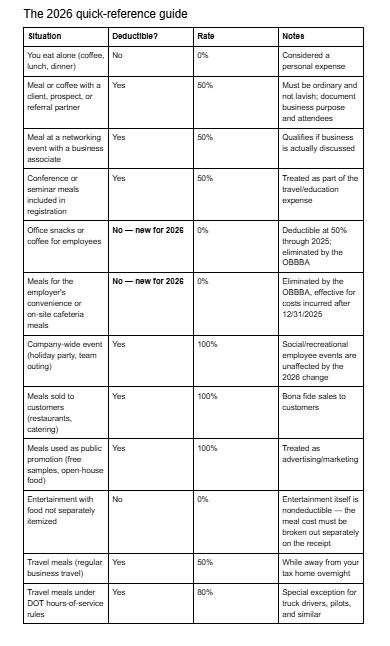
Starting January 1, 2026, employers can no longer deduct the cost of:
Office snacks and coffee provided to employees. These were deductible at 50% through 2025. As of 2026, that deduction is gone.
Meals provided for the employer's convenience (think: working lunches during a busy stretch, or food provided so employees stay on-site).
Meals from an employer-operated or on-site cafeteria, whether you run it or a third party does.
There are a few narrow industry exceptions — restaurants providing meals to their own employees, and fishing-vessel crews — but if that's not your business, assume these categories are now fully nondeductible.
What didn't change: meals with clients, prospects, or referral partners; travel meals; and meals tied to genuine business entertainment or promotion. Those keep their existing deduction rates, detailed below.
How to document a meal so it holds up
A 50% deduction is only as good as your records. If the IRS asks, you'll want to show, for each meal:
Who — the names and business relationship of everyone at the table (a client, a referral partner, a prospect — not just "team lunch")
What business purpose — what you discussed or intended to discuss
When — the date
Where — the location or restaurant
How much — an itemized receipt showing the amount, not just a credit card slip
A quick note in your phone or bookkeeping app right after the meal — while it's still fresh — is enough. What trips people up isn't the deduction itself, it's a shoebox of receipts with no context six months later.
A few practical habits that make this painless:
Log it the same day. Even a one-line note ("Lunch w/ Jane Smith, referral partner, discussed Q1 partnership — $42") is enough to substantiate the deduction.
Keep the itemized receipt, not just the card slip. If food and entertainment are on the same bill (a ballgame with dinner, for example), ask for the meal cost broken out separately — otherwise the whole thing can be treated as nondeductible entertainment.
Separate categories in your books now. If you've been coding "employee meals," "client meals," and "office snacks" all to one account, 2026 is the year to split them — since they're no longer taxed the same way, your bookkeeping shouldn't treat them the same way either.
Hang onto records for at least three years, in line with the general IRS statute of limitations for audits.
The bottom line
Client meals, travel meals, and business entertainment food are still solid, well-established deductions — just document them properly. Office snacks and convenience meals for your team, on the other hand, lost their deduction starting this year, so it's worth updating how you (or your bookkeeper) are categorizing those expenses.
If you're not sure how a specific meal expense should be coded, or want your books cleaned up to reflect the 2026 changes, that's exactly what we're here for — reach out and we'll sort it out together (no cat-and-mouse chasing you for receipts required).
— Two Cats Bookkeeping 🐾
“Keeping your books tidy without using up your nine lives.”
This post is general information based on current IRS guidance and the One Big Beautiful Bill Act, and isn't a substitute for advice specific to your situation. Talk with your tax professional before making decisions based on it.

Two Cats Bookkeeping
Serving small businesses in St. Petersburg, FL & across the U.S.
QUICK LINKS
READY TO GET STARTED?
© 2026 Two Cats Bookkeeping. All rights reserved.